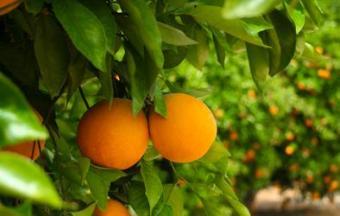
Seen here, the appearance of fruitesticles have brought the citrus industry to a grinding halt.
Florida – The increase in masturbation by unclean Mexican immigrants while working in Commercial Orange Groves has caused an unprecedented new disease to strike America’s precious store of citrus fruits.
The disease, known as Fruitesticling, has infected almost 70% of citrus in Florida over the past few years. It reached California also in 2008.
There is a fear that if this disease is not combated, then it may have the potential to wipe out the entire industry in the next few years. It has very destructive elements and is coaxing researchers to look for solutions.
Not surprisingly, many immigrant pickers have shown great pride in their new creation – hoping that it will become an American tradition to indulge in their sinful fruits.
“I would like man to suck juice from my ripe and delicious testicles,” says Juan Ramirez, an undocumented worker that smells like he hasn’t seen a bar of soap in months. ‘It’s good for you, try it!”
But according to Steven Phipott, Director of Biological Research at the University of Florida, the appearance of Fruitesticles may have a tremendously negative effect for the future of citrus fruits.
“This is not something to be proud of – this is a travesty. These are no longer oranges – they don’t taste the same. Salty, that would be my first effort to describe them.”
There is a ray of hope after researchers at the University of Florida claimed that this deadly disease could be fought through prayer and careful biological spraying of immigrant pickers. Till now, there was no cure for Fruitesticling. The infected trees had to be cut to keep the strange growths from spreading to other trees.
The chemical benzbromarone, which is used to treat gout in humans, was quite effective in limiting the spread of the fruitesticling in infected trees. Sprayed on Mexican immigrants, many of who have not bathed in weeks, the chemical binds to a protein called LdtR in their DNA. The protein then gets deactivated, which disrupts a process that the fruitesticles need to survive on the tree.
The researchers also tested other two chemicals, which had some effect toward inhibiting the spread of Fruitesticles. The chemicals are: Hexestrol, a carcinogenic synthetic estrogen compound, and phloretin, which helps in the absorption of glucose into the small intestine. Neither of them was as effective as the gout medication.

Dirty immigrants, proudly displaying their genetically mutated horrors.
The chemicals have only been tested in the lab as of now. So, there is no idea as to how they will work in the field. The process of protecting the spread of fruitesticles could take five to seven years more, according to top scientists.